Finasteride Therapy for Advanced Hair Thinning in Korea
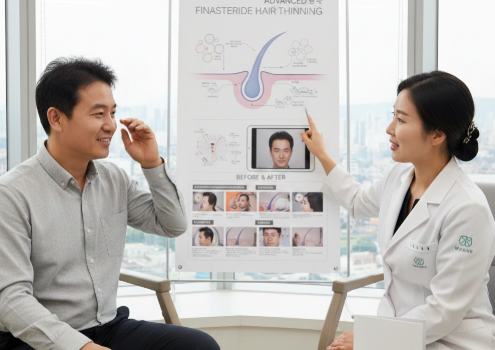
Treatment Overview Advanced hair thinning, often seen in later stages of androgenetic alopecia, can cause noticeable hair loss on the crown, vertex, and frontal scalp.

Treatment Overview Advanced hair thinning, often seen in later stages of androgenetic alopecia, can cause noticeable hair loss on the crown, vertex, and frontal scalp.

Treatment Overview Alopecia areata (AA) is an autoimmune condition that causes patchy hair loss on the scalp and other areas. While the primary treatment is

Treatment Overview Early-stage hair loss, often characterized by thinning at the crown or receding hairline, can be effectively treated with Finasteride Therapy. In Korea, Finasteride

Treatment Overview Although Finasteride is traditionally used for male-pattern hair loss, Korean dermatology clinics have adapted protocols for female hair loss in carefully selected cases.
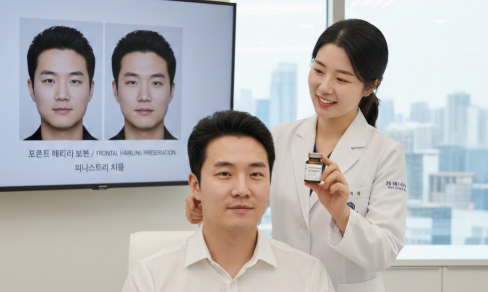
Treatment Overview Frontal hairline thinning is one of the earliest and most noticeable signs of male-pattern baldness. Finasteride Therapy is widely used in Korea to

Treatment Overview Postpartum hair loss, also known as telogen effluvium, affects many women after childbirth due to hormonal fluctuations, particularly the drop in estrogen levels.

Treatment Overview A receding hairline is often the first visible sign of male pattern baldness, caused primarily by DHT sensitivity in hair follicles. Finasteride Therapy

Treatment Overview Stress-induced hair loss, also known as telogen effluvium, occurs when excessive stress pushes hair follicles into the resting phase, leading to increased shedding.

Treatment Overview Finasteride and Dutasteride are both oral medications that inhibit 5-alpha-reductase, the enzyme responsible for converting testosterone into dihydrotestosterone (DHT), a key factor in

Treatment Overview Finasteride and Minoxidil are two of the most widely used treatments for male-pattern hair loss (androgenetic alopecia). In Korea, dermatology clinics offer both
Treatment Overview Advanced hair thinning, often seen in later stages of androgenetic alopecia, can cause noticeable hair loss on the crown, vertex, and frontal scalp.
Treatment Overview Alopecia areata (AA) is an autoimmune condition that causes patchy hair loss on the scalp and other areas. While the primary treatment is
Treatment Overview Early-stage hair loss, often characterized by thinning at the crown or receding hairline, can be effectively treated with Finasteride Therapy. In Korea, Finasteride
Treatment Overview Although Finasteride is traditionally used for male-pattern hair loss, Korean dermatology clinics have adapted protocols for female hair loss in carefully selected cases.
Treatment Overview Frontal hairline thinning is one of the earliest and most noticeable signs of male-pattern baldness. Finasteride Therapy is widely used in Korea to
Treatment Overview Postpartum hair loss, also known as telogen effluvium, affects many women after childbirth due to hormonal fluctuations, particularly the drop in estrogen levels.
Treatment Overview A receding hairline is often the first visible sign of male pattern baldness, caused primarily by DHT sensitivity in hair follicles. Finasteride Therapy
Treatment Overview Stress-induced hair loss, also known as telogen effluvium, occurs when excessive stress pushes hair follicles into the resting phase, leading to increased shedding.
Treatment Overview Finasteride and Dutasteride are both oral medications that inhibit 5-alpha-reductase, the enzyme responsible for converting testosterone into dihydrotestosterone (DHT), a key factor in
Treatment Overview Finasteride and Minoxidil are two of the most widely used treatments for male-pattern hair loss (androgenetic alopecia). In Korea, dermatology clinics offer both